Sonnet 43
Sonnet 43 is Elizabeth Barrett Browning's most famous and passionate declaration of love. It offers an excellent opportunity to explore how Victorian religious devotion can be woven into deeply personal romance, providing rich material for analysing form, structure, and poetic methods.
Study Notes
Overview
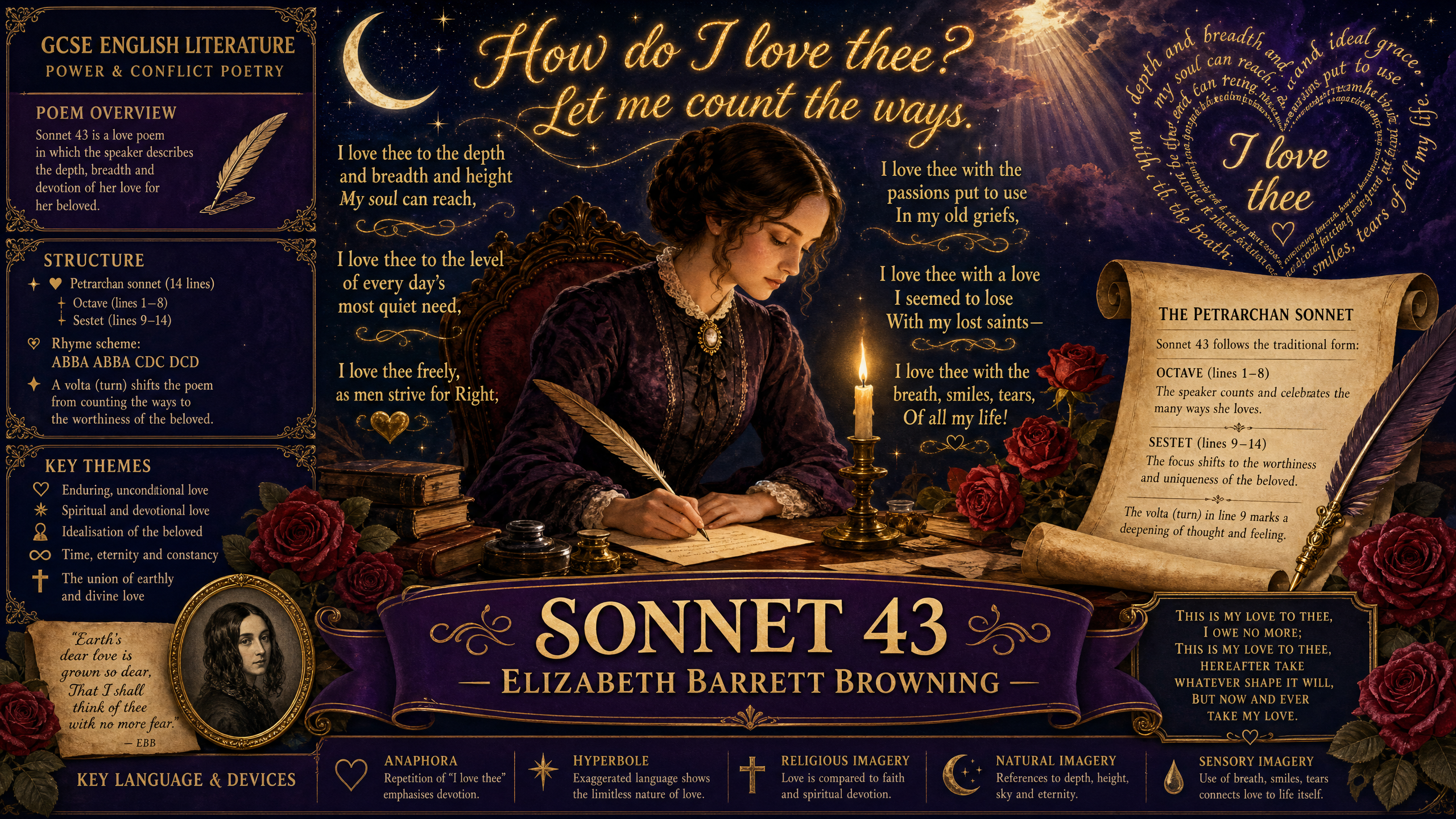
Sonnet 43, part of the Sonnets from the Portuguese (1850) collection, is Elizabeth Barrett Browning's ultimate expression of enduring, unconditional love. Written in secret to her future husband, Robert Browning, the poem attempts to quantify the unquantifiable. For GCSE Literature candidates, this poem is a goldmine. Examiners consistently reward those who can move beyond simply identifying the poem as a 'love poem' to analysing how the speaker uses the rigid Petrarchan sonnet form to contain overwhelming emotion. Key areas to focus on include the use of anaphora, spatial imagery, and the profound integration of religious devotion with romantic love. Strong responses will always address the volta (turn) at line 9 and how it shifts the poem's focus from earthly measurement to spiritual eternity.
Poem Overview
Unlike a play or novel, a sonnet does not have a 'plot', but it does have an argument or narrative progression:
- The Octave (Lines 1-8): The speaker attempts to measure her love in earthly, spatial, and everyday terms. She maps her love across three dimensions ("depth and breadth and height") and links it to daily necessity ("sun and candle-light").
- The Volta (Line 9): The poem shifts in tone and focus.
- The Sestet (Lines 9-14): The speaker moves from the present and the earthly to the past and the eternal. She connects her current love to her past griefs and lost faith, culminating in the hope that her love will survive and even grow stronger after death.
Themes
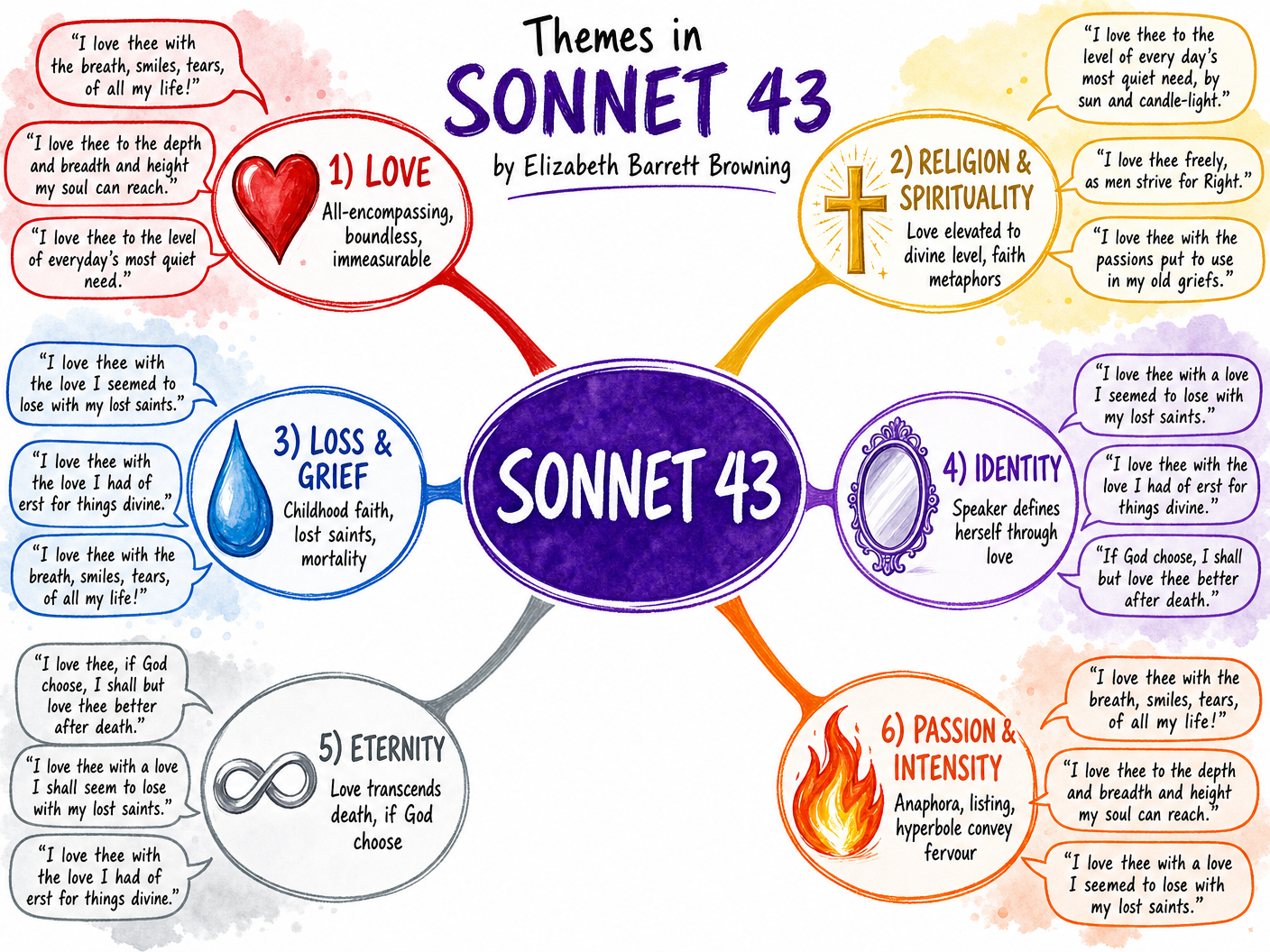
Theme 1: Boundless and All-Encompassing Love
The most prominent theme is the overwhelming, immeasurable nature of love. The speaker attempts to define something infinite using finite measurements, ultimately showing that true love encompasses every aspect of existence.
Key Quotes:
- "How do I love thee? Let me count the ways." (Line 1) - The rhetorical question sets up the poem's central premise. The speaker already knows the answer cannot be fully quantified.
- "I love thee to the depth and breadth and height / My soul can reach" (Lines 2-3) - The use of a triadic structure (three elements) attempts to map love onto physical dimensions, while "soul" elevates it beyond the physical.
Theme 2: Religion and Spiritual Devotion
Barrett Browning frequently uses religious terminology to elevate her earthly love to a divine status. This is not blasphemous; rather, it is the highest compliment she can offer, suggesting her love for her husband is as profound as her love for God.
Key Quotes:
- "For the ends of Being and ideal Grace." (Line 4) - Capitalisation of "Being" and "Grace" links her love to God and spiritual perfection.
- "With my lost saints" (Line 12) - A metaphor for the people she has lost (like her brother) or the religious fervour of her youth. She has redirected this intense devotion toward her beloved.
Theme 3: Time, Mortality, and Eternity
The poem acknowledges the fleeting nature of human life but posits that love can transcend death. The progression moves from the everyday to the eternal.
Key Quotes:
- "I love thee to the level of every day's / Most quiet need" (Lines 5-6) - Love is not just grand and spiritual; it is also constant, domestic, and necessary for survival.
- "I shall but love thee better after death." (Line 14) - The poem concludes with a powerful assertion of eternal love, conditional only on God's will ("if God choose").
Writer's Methods
Form and Structure
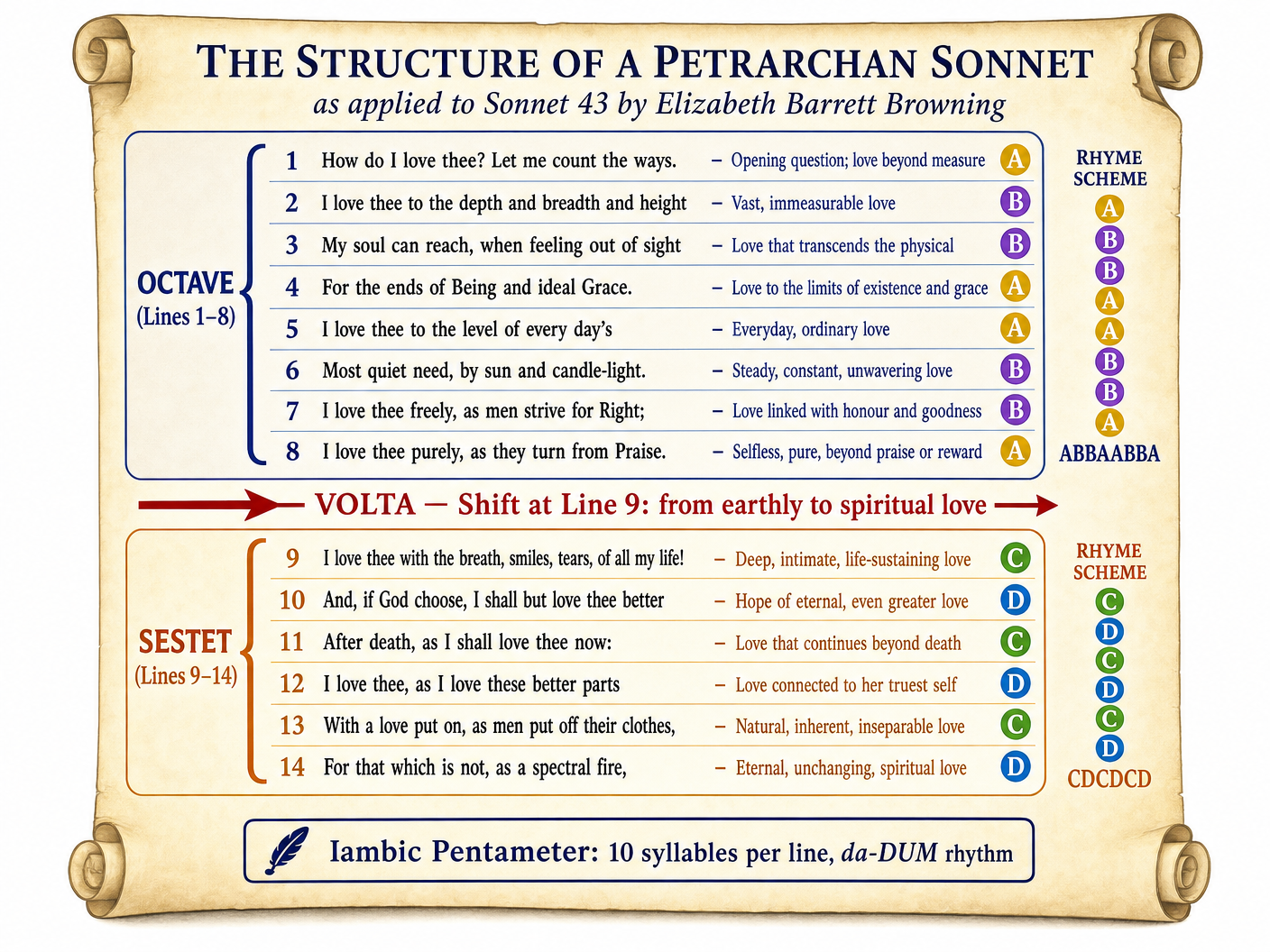
- Petrarchan Sonnet: 14 lines divided into an octave (ABBAABBA) and a sestet (CDCDCD). This form is traditionally used for expressing intense, often unrequited love, but Barrett Browning adapts it for mutual, fulfilled love.
- The Volta: The shift at line 9 ("I love thee with the breath...") marks a transition from abstract, spatial measurements of love to deeply personal, emotional, and historical experiences of love.
- Iambic Pentameter: The steady ten-syllable rhythm (da-DUM da-DUM) mirrors a heartbeat, reflecting the constancy and naturalness of her affection.
Language and Imagery
- Anaphora: The repetition of "I love thee" (used eight times or implied) creates an incantatory, cumulative effect. It shows a speaker overwhelmed by emotion, needing to repeatedly assert her devotion.
- Listing/Asyndeton: The listing of ways she loves him builds intensity and pace, suggesting a love so vast it cannot be contained in a single statement.
- Metaphor: "spectral fire" (often contrasted with true love) or the "lost saints" which metaphorically represent her past religious zeal or lost loved ones.
Context
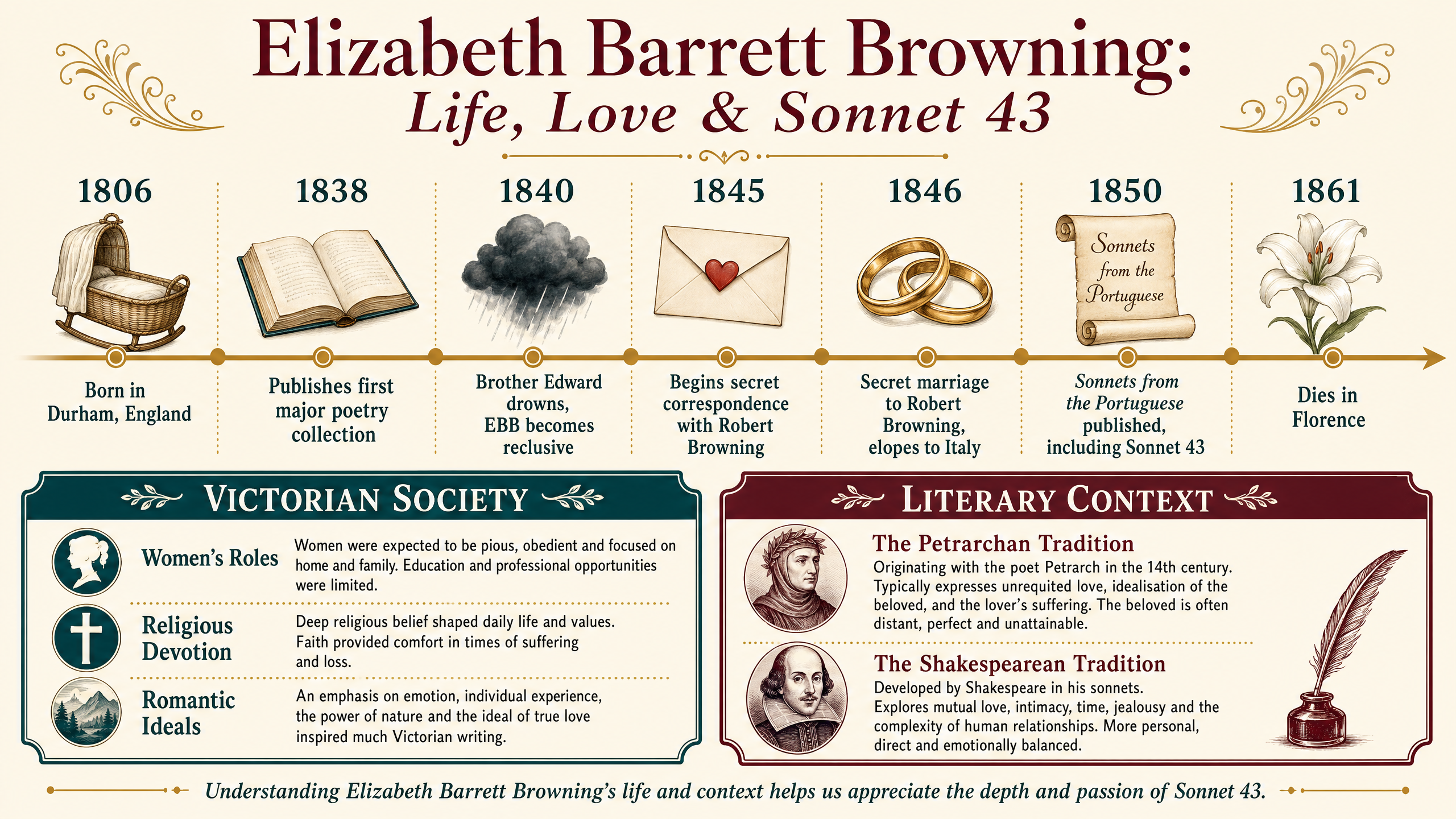
- Biographical Context: Elizabeth Barrett Browning suffered from chronic illness and lived under the control of a strict, overbearing father. Her courtship with Robert Browning was conducted in secret through hundreds of letters. They eventually eloped to Italy. This poem reflects the profound liberation and joy she found in this relationship.
- Victorian Religion: The Victorian era was characterised by deep religious faith. The poem's blending of earthly romance with Christian devotion ("ideal Grace", "lost saints", "if God choose") would have resonated strongly with contemporary readers, showing love as a holy, sanctified emotion.
- Sonnets from the Portuguese: Published in 1850, the title was a deliberate disguise to make the deeply personal poems seem like translations, protecting her privacy in conservative Victorian society.
Visual Resources
3 diagrams and illustrations
Interactive Diagrams
1 interactive diagram to visualise key concepts
Conceptual Flow Outline
The Argument Structure of Sonnet 43
Worked Examples
2 detailed examples with solutions and examiner commentary
Practice Questions
Test your understanding — click to reveal model answers
Compare how poets present the power of love in Sonnet 43 and in one other poem from your anthology.
Hint: Consider how love is shown to be powerful: is it a spiritual power, an emotional power, or a destructive power? Choose a comparative poem that either shares this spiritual intensity or contrasts with it by showing love's dark side.
How does Barrett Browning use religious imagery to convey her feelings in Sonnet 43?
Hint: Focus specifically on quotes like 'ideal Grace', 'lost saints', and 'if God choose'. Explain how this elevates her love.
Explore the significance of the ending of Sonnet 43.
Hint: Look at the final two lines. How do they resolve the argument set up in line 1?
How is the theme of time presented in Sonnet 43?
Hint: Think about the past ('old griefs'), the present ('every day's most quiet need'), and the future ('after death').